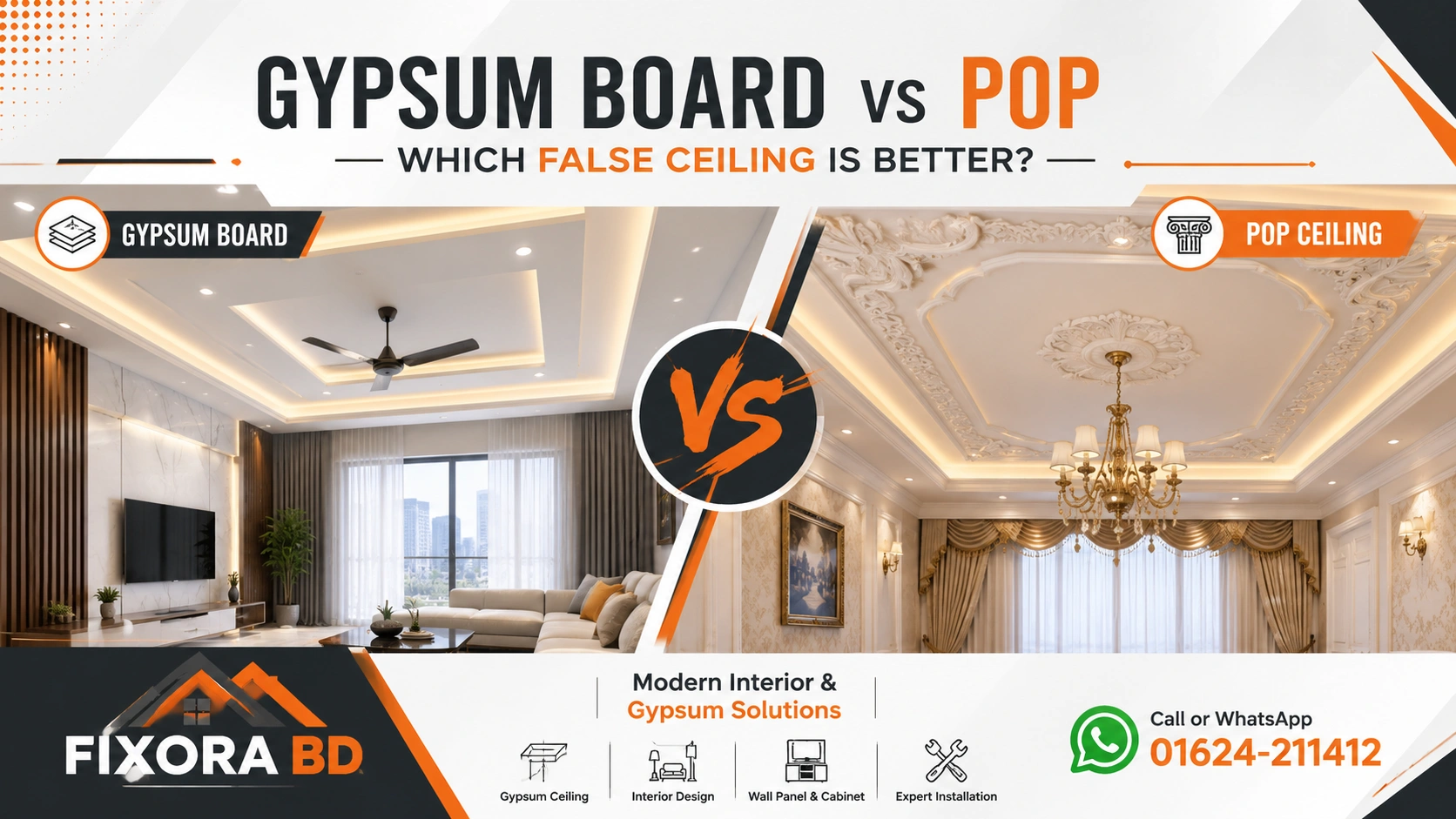
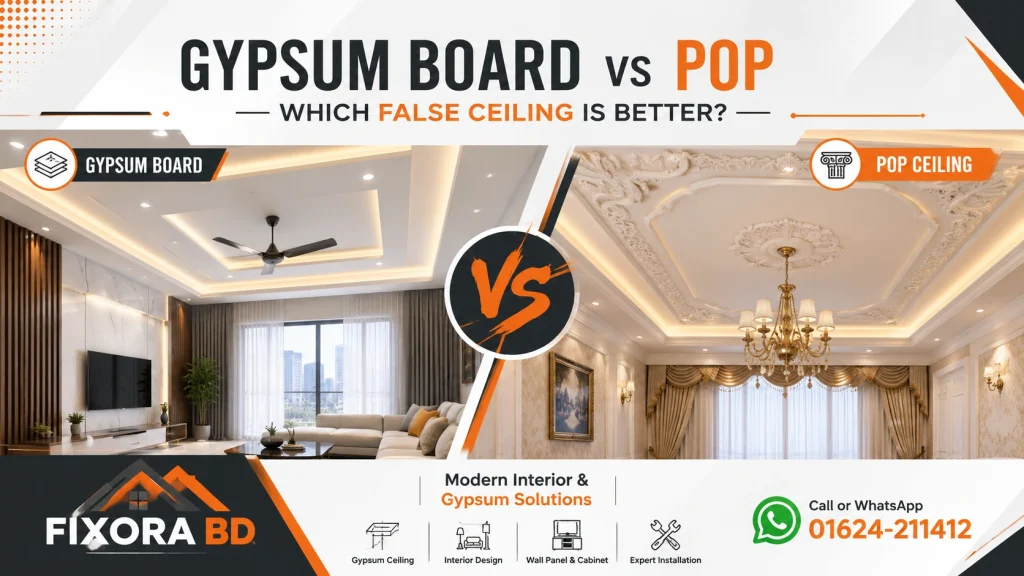
Quick answer: For most homes in Bangladesh, gypsum board is the better choice over POP (Plaster of Paris) — it installs faster, handles humidity better when moisture-resistant boards are used, supports more intricate designs like multi-level ceilings and LED cove lighting, and is easier to repair later. POP can cost slightly less for very basic flat designs, but it takes longer to install, creates more on-site mess, and is harder to patch if damaged. Below is a full side-by-side comparison so you can decide based on your actual room, budget, and design goals.
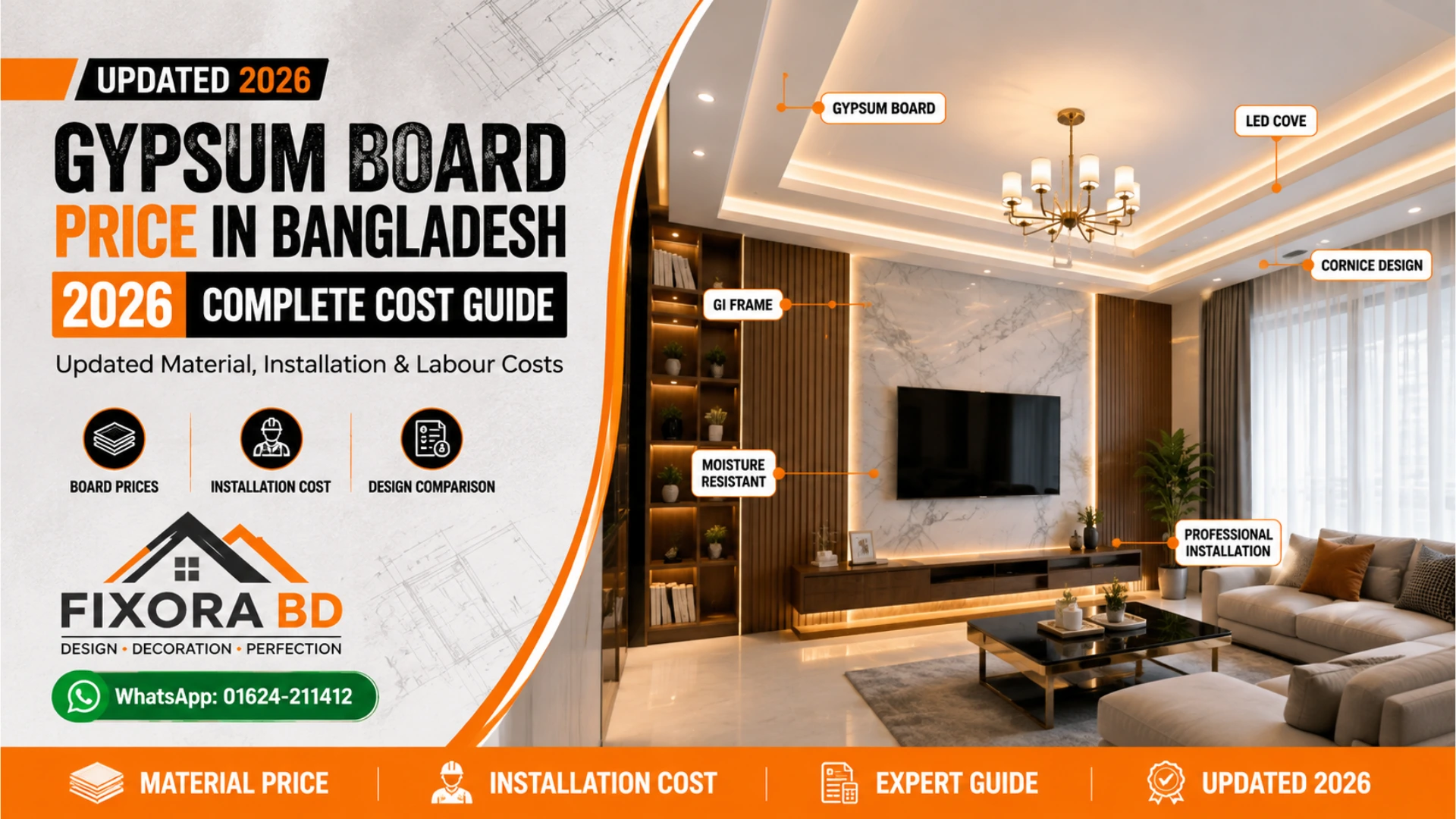
If you’re still deciding between the two, it also helps to know the real numbers — see our full gypsum board price guide and false ceiling cost breakdown for current 2026 rates in Bangladesh.
What Is Gypsum Board?
Gypsum board (also called drywall or plasterboard) is a factory-made panel with a compressed gypsum core wrapped in paper facing. It’s screwed onto a metal or wood frame to create a false ceiling, then finished with putty and paint. Because the boards arrive pre-formed and consistent in thickness, installation is largely a fitting-and-finishing job rather than a wet, on-site process — which is why it’s become the standard choice for home interior design projects across Dhaka over the past decade.
What Is POP (Plaster of Paris)?
POP is a powder made from gypsum that’s mixed with water on-site and applied wet, either directly onto a wire mesh frame or over an existing surface, then hand-shaped and left to dry and set. It’s an older technique than gypsum board installation and was the standard false-ceiling method in Bangladesh before pre-made boards became widely available. POP can be molded into custom shapes by a skilled worker, but the entire process — mixing, applying, shaping, and drying — happens on-site and takes considerably longer than fitting a pre-made board.
Gypsum Board vs POP: Full Comparison Table
| Factor | Gypsum Board | POP (Plaster of Paris) |
| Installation time | Faster — boards are pre-made, mainly a fitting job | Slower — mixed, applied, and dried on-site |
| Site mess | Minimal — dry installation | Significant — wet material, dust, drying time |
| Design flexibility | High — supports multi-level, cove lighting, precise cuts | High for hand-molded custom shapes, but less consistent |
| Moisture resistance | Good with moisture-resistant (green) boards | Weaker — more prone to damage in humid conditions |
| Weight | Lighter — less load on the ceiling structure | Heavier once fully applied and dried |
| Repair | Easier — damaged sections can be cut out and patched | Harder — repairs often show visible texture mismatch |
| Finish consistency | Very consistent, factory-made thickness | Depends heavily on the individual worker’s skill |
| Cost (basic design) | Slightly higher material cost, faster labour | Slightly lower material cost, but labour time adds up |
| Cost (complex design) | More cost-efficient for detailed, layered designs | Becomes expensive and slow for intricate shapes |
| Lifespan with proper install | Long-lasting, minimal sagging with correct framing | Can crack over time, especially with structural movement |
| Best suited for | Modern homes, offices, most residential ceilings | Traditional, heavily hand-molded ceiling art (less common now) |
Which Handles Bangladesh’s Climate Better?
Bangladesh’s humidity is one of the most important — and most overlooked — factors in this decision. Standard building materials that perform fine in drier climates can behave differently here, especially in kitchens, bathrooms, and ground-floor rooms near water sources.
Gypsum board performs noticeably better in humid conditions when the right board type is used. Moisture-resistant (green) boards are specifically formulated to resist swelling and mold growth in damp areas, which is why we recommend them for kitchen and bathroom ceilings rather than the regular board used elsewhere in a home.
POP, being applied wet and drying naturally, is more sensitive to ongoing humidity exposure after installation. In poorly ventilated rooms, POP ceilings can develop surface cracks or discoloration over time as the material continues reacting to ambient moisture — something that’s less of a concern with a properly sealed gypsum board installation.
For any room with regular moisture exposure — kitchens, bathrooms, and rooms near the building’s exterior in monsoon-heavy areas — gypsum board with the correct moisture-resistant grade is the safer long-term choice.
Design Flexibility: Which Supports Modern Designs Better?
Both materials can be shaped into detailed designs, but the process differs in a way that affects the final result:
- Multi-level and stepped ceilings — gypsum board’s pre-cut panels make consistent step heights and clean edges easier to achieve. POP can do this too, but relies more on the individual worker’s precision.
- LED cove lighting channels — gypsum board framing naturally supports the recessed channel design used for cove lighting, and has become the standard material for this popular design in Dhaka living rooms.
- Cornice and border detailing — this is one area where POP historically excelled, since it can be hand-molded into ornate, traditional patterns. However, most modern gypsum cornice designs now use pre-molded gypsum decorative pieces that achieve a similar (or cleaner) look with far more consistency between rooms.
- Geometric and angular patterns — gypsum board’s factory-cut precision makes sharp angles and repeated geometric patterns easier to replicate accurately across a large ceiling.
For most contemporary Bangladeshi homes, the designs people are actually requesting — cove lighting, clean multi-level steps, geometric patterns — are all things gypsum board handles more consistently.
Repair & Maintenance Compared
This is where the two materials diverge the most in real, long-term homeowner experience:
Gypsum board repairs are relatively straightforward. A damaged section — from water leakage, an accidental impact, or an electrical rework — can usually be cut out and replaced with a matching patch, then re-puttied and painted. Because the board has a consistent factory thickness, a skilled installer can blend a repair so it’s barely visible.
POP repairs are harder to match. Since the original surface was hand-applied and dried under specific site conditions, a patch job often has a slightly different texture or shade, especially if the surrounding paint has aged. Cracks along POP surfaces — common where the material meets a wall or another ceiling section — also tend to reappear at the same spot if the underlying cause (usually structural movement) isn’t addressed first.
If you expect to update wiring, lighting, or AC positioning in the future, gypsum board’s easier repairability is a meaningful long-term advantage, not just a cosmetic one.
Which One Do Different Homeowners Actually Choose?
Seeing how real clients decide often clarifies this better than specs alone. Based on the projects we take on across Dhaka, the pattern looks roughly like this:
- New apartment owners furnishing from scratch almost always choose gypsum board — it fits the modern, clean-lined look most new flats are designed around, and pairs naturally with the rest of a full interior design package (cabinets, wall panels, lighting).
- Homeowners renovating an older house sometimes ask about POP if the existing ceiling already has POP detailing they want to match or extend. In these cases, we’ll typically recommend matching the existing material only where it meets old work, and switching to gypsum board for any new sections.
- Commercial and office spaces lean almost entirely toward gypsum board, since faster installation means less business disruption, and consistent, repeatable panel sizes suit large open ceiling areas better than hand-applied POP.
- Clients wanting ornate, traditional ceiling art — a smaller group, but a real one — are the main remaining case where POP’s hand-molding capability is genuinely the better fit.
If your situation matches one of the first three, gypsum board is very likely the right call. If you’re in the last group, it’s worth discussing both options with an installer who’s comfortable working in either material, rather than one who only offers one or the other.
Our Recommendation
At Fixora BD, we install both materials, but we recommend gypsum board for the large majority of residential and office projects in Bangladesh — mainly because of three practical reasons we see play out repeatedly on real projects: faster installation with less disruption to your home, better moisture handling with the right board grade, and much easier repairs down the line.
The one case where POP still makes sense is for clients specifically wanting traditional, heavily ornate hand-molded ceiling art that isn’t achievable with standard pre-molded gypsum pieces — a niche preference, but a valid one if that’s the look you want.
For everything else — modern living rooms, bedrooms, kitchens, offices, and any design involving cove lighting or multi-level steps — gypsum board gives you a faster installation, a more consistent finish, and a ceiling that’s easier to live with and repair for years afterward. If you’re weighing this decision for your own space, our team can walk through your specific room and design goals during a free site visit and recommend the right material and board grade for each room.
FAQs
Is gypsum board better than POP for false ceilings?
For most modern homes in Bangladesh, yes — gypsum board installs faster, handles humidity better with the right board grade, and is easier to repair. POP remains a valid choice mainly for traditional, heavily hand-molded ceiling designs.
Which is cheaper, gypsum board or POP?
For very basic flat designs, POP material can be marginally cheaper, but gypsum board’s faster installation often closes the cost gap. For detailed or multi-level designs, gypsum board is usually more cost-efficient overall.
Does POP ceiling crack easily in Bangladesh’s climate?
POP can be more prone to surface cracking over time in humid, poorly ventilated spaces, especially where structural movement is present. Gypsum board with proper framing is generally more stable in these conditions.
Can gypsum board be used in bathrooms and kitchens?
Yes, but a moisture-resistant (green) gypsum board should be used in these areas rather than standard board, to resist swelling and mold growth from ongoing humidity exposure.
Which material is better for LED cove lighting designs?
Gypsum board is the standard choice for LED cove lighting, since its framing naturally supports the recessed channel design this style requires.
How long does a gypsum board ceiling last compared to POP?
Both can last many years with correct installation, but gypsum board tends to hold its finish more consistently over time, while POP is more susceptible to surface cracking if humidity or structural movement isn’t accounted for.